PRO
CLINICAL KNOWLEDGE MAGAZINE
6 min read
Reducing Body Weight Can Be Enjoyable!

Julia Wójcik
✓
Diets Premium Medical Expert • 19.03.2026
✓
Scientifically reviewed by a clinical dietitian:
This article has been peer-reviewed for adherence to IŻŻ, WHO, and PTGiP clinical nutritional standards.
| CLINICAL KNOWLEDGE MAGAZINE CLINICAL KNOWLEDGE MAGAZINE | min read 6 min |
| Diets Premium Medical Expert Julia Wójcik | Scientifically reviewed by a clinical dietitian 19.03.2026 |

Smart Voice
•Listen to the article content live
0:00
/
0:00
Key Takeaways
In numerous instances, terms such as diet and weight loss are correlated with negative emotions and perpetual endeavors to resist temptations... Effective weight loss is undoubtedly linked to certain restrictions, but not to the degree that one might envision.
Meal Plan
Want to apply these guidelines in your daily diet?
Our smart diet generator creates a tailored meal plan in 3 minutes based on the recommendations in this article.
PRO Content
PRO
This article is professional premium content (PRO) provided in its entirety.
The Weakness of Strong Will
Formerly popular 1000-calorie diets have become outdated. It's time to debunk the myth of weight loss as an endless hunger strike. The ability to control oneself is limited in the diet. So it's impossible to completely give up on high-calorie treats. Research by J. W. Anderson and his colleagues has shown that the majority of people who have lost weight in the past have returned in the middle of the last two years. There are several possible causes, such as the adaptation of the body and the reduction of energy consumption with weight loss, the physiological defense of the organism against weight loss (e.g., the automatic increase of appetite with weight loss). It's difficult to stick to a strict diet for a long time. The will is limited, and the constant use of it exhausts it. This was confirmed by an experiment in which participants who resisted the temptation to eat cookies gave up faster in completing a difficult geometric puzzle (R. F. Baumeister and colleagues 1998). There are probably biological reasons. M. Inzlicht, J. Gutsell observed less activity in the brain responsible for cognitive functions in people who performed tasks that required self-control (suppressing emotions while watching a touching film) compared to a control group. Research shows that suppressing something or the same thing exhausts strong will, and each subsequent task that requires self-control becomes significantly more difficult. A long-term diet cannot be an endless stream of challenges. A diet should also be beneficial for mental well-being. It should have a positive impact on well-being and not limit social life. Weight loss is a long-term process and should not turn life upside down. Is there such a way of eating that allows you to stay healthy, get rid of excess kilos, and maintain a good mood?
The principle that 80% consists of nutritious components and only 20% consists of favorite products
The principle advocated by Teresa Cutter is that 80% of the daily calories should come from nutritious and healthy components, and only 20% of the calories should come from favorite products that are not always healthy. A person on an energy-efficient diet of 2000 kcal should provide 1600 kcal from foods that are as minimally processed as possible, rich in vitamins and minerals, and 400 kcal can be taken from products that they like. However, applying this rule requires counting calories. The focus is on consuming foods that support the functioning of the body, rather than restrictions.
Lighter iterations of your most popular dishes
Here are several pieces of advice on how to decrease the calorie count in meals.
Rejecting liquid kilocalories
Liquid kilocalories are also present in beverages, even those that appear healthy. An example is fruit juice. One glass of orange juice contains approximately 100 kcal – as much as in a small glass of milk. Replacing 2 glasses of juice with 2 glasses of water can reduce the calorie intake of the diet by about 200 kcal. Furthermore, the impact of daily fruit juice consumption on health is unclear. Some studies indicate that regular consumption of juices may increase the risk of elevated LDL cholesterol levels in the blood (G. Ravn-Haren et al. 2013).
Natural yogurt as an alternative to cream
Replacing cream with natural yogurt in recipes can be advantageous. 100 grams of yoghurt contains 60 calories, while 100 grams of cream 12% contains 134 calories. Savings: 74 calories.
Grilling instead of Deep-Frying
Preparing food in the oven, for example, in aluminum foil, requires significantly less fat than deep-frying. During deep-frying, depending on the quality of the pan, more oil or other fat may be used. A tablespoon of rapeseed oil is about 90 kcal. For deep-frying, for example, pork chops, usually more than one tablespoon (about 2-3 tablespoons) is needed. Therefore, one can replace deep-frying with preparing food in the oven. A pork chop can be replaced with a pork chop prepared on the grill in aluminum foil. Saved calories: 90 kcal. Unsaturated fatty acids in the diet in the form of rapeseed oil or olive oil are necessary. One should not avoid them, but use them in moderation. A good solution would be the use of oil bottles with a spray head.
Egg in a shirt instead of a planted egg
The planted egg during preparation necessitates fat (at least 1 tablespoon). Cooking eggs in water enables achieving the appropriate consistency without additional superfluous calories. Savings: 90 kcal.
Sorbet instead of cream-based ice cream
Creamy chocolate ice cream is genuinely delicious, but it is also highly calorific -- one ounce (about 50 grams) can deliver up to 125 calories -- a scoop of raspberry sorbet is approximately 60 calories. Difference: 65 calories.
A Hamburger Sandwich Excluding the Bread Bun
The renunciation of bread will undoubtedly lower the caloric intake. A burger accompanied by various ingredients can be wrapped in lettuce leaves. Savings: 157 kcal Following these few guidelines, you can decrease your diet's caloric content by as much as 676 kcal.
Vegetables as the foundation
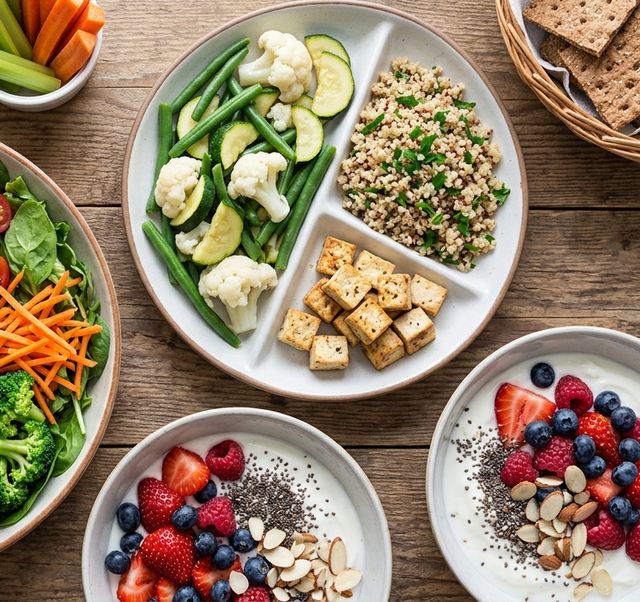
The dominance of vegetables (at least 50%, except potatoes) in a meal's composition can make it tens of percent less caloric than dishes dominated by, say, meat or pasta. Vegetables are typically lower in calories and more nutrient-dense than other ingredients.
The consumption of soup prior to the main course
The ingestion of a light soup might potentially diminish the magnitude of the subsequent meal, as evidenced in a study where participants, subsequent to consuming soup, ingested 20% less than their customary intake (J. E. Flood, B. J. Rolls 2007).
Avoiding intense emotions during meal consumption
In the publication 'Emotionally Influenced Food' the results of a study are cited that show that emotions have a significant impact on the amount of food we eat. People who are under the influence of strong emotions, both positive and negative, eat more and more often choose snacks with high calorie content. Reactions to emotions can vary from person to person, so it's worth watching your own reactions. The study shows that women eat more when they are in a good mood. However, when asked to recall what they ate in their previous meal, the amount of food consumed decreased.
The suitable quantity of sleep
A brief sleep duration is correlated with a high consumption of calories and fat. A decrease in sleep duration may be associated with a decline in the hunger-alleviating hormone leptin and an increase in the appetite-promoting hormone ghrelin (K. Spiegel et al., 2004). M. P. St-Onge et al. observed a stronger brain response to unhealthy food rewards in individuals who slept less (4 hours) compared to those who slept for 9 hours a day. Incorporating some of these principles into the diet could be an excellent starting point for positive changes. A thoughtful, non-radical approach to changing eating habits is the most effective and offers hope for long-term results.
Julia Wójcik
Diets Premium Medical Expert
Member of the Diets Premium clinical editorial board. Specializes in medical diet therapy, metabolic health, and nutritional planning.
View Profile →