Nordic Walking: Technique, Benefits, and Scientific Foundations

| Diets Premium Expert Anna Schmidt | min read 6 min | Scientifically reviewed by a clinical dietitian 23.10.2026 |
Smart Voice
•Listen to the article content live
The physical activity known as Nordic walking has achieved widespread adoption owing to its remarkable accessibility and minimal equipment requirements. This recreational pursuit, which involves a purposeful walking motion augmented by the use of specially designed poles, can be engaged in by individuals across all age groups and fitness levels, regardless of geographic setting or urban infrastructure. What has proven particularly surprising, however, is that rigorous scientific research has demonstrated how mastering the precise technique of this discipline yields an extensive array of health benefits—benefits whose scope far exceeds the initial expectations of both casual participants and sports medicine professionals alike. This article delves into the correct execution, various training levels, and the proven positive effects on health.
Want to apply these guidelines in your daily diet?
Our smart diet generator creates a tailored meal plan in 3 minutes based on the recommendations in this article.
This article is professional premium content (PRO) provided in its entirety.
Nordic Walking: Definition, History, and Fundamentals
Nordic walking is a form of physical activity originating from 1920s Finland, where it initially served as year-round conditioning training for cross-country skiers during the off-season. It was not until 1997, following a publication by Marko Kantaneva, that this training method gained recognition as an independent sport and spread globally. Compared to ordinary walking, Nordic walking is distinguished by the use of specially designed poles that engage a much larger muscle mass.
Walking with poles activates the shoulder girdle, chest muscles, arms, and core, stimulating them more effectively than standard walking or running. Nordic walking promotes upper-body strength and endurance, increases caloric expenditure, and facilitates hill climbing. Furthermore, it enhances stability—crucial for individuals with weaker joints and muscles—by reducing impact forces on the shins, knees, hips, and spine.
The primary advantage of Nordic walking lies in its accessibility: there are no age, fitness, or body weight restrictions, and it can be practiced year-round across diverse terrains such as beaches, forests, mountains, or urban settings. However, it is strongly recommended to start under the guidance of an experienced instructor to master the correct walking technique and select appropriate poles.
Training Levels and Equipment Selection
Prior to starting Nordic walking, proper equipment selection—especially pole length—is crucial. Pole length can be calculated by multiplying the user's height by 0.68 to 0.72, or by ensuring that the elbow forms a right angle when the pole is held vertically on the ground.
Nordic walking can be practiced across three distinct intensity levels:
- Health level: Designed primarily for individuals working on their basic fitness, undergoing rehabilitation after injuries or surgeries, and those aiming for weight loss. It improves cardiorespiratory function and significantly unloads knee joints.
- Fitness level: Targeted at individuals looking to further enhance their physical conditioning. Training should be performed systematically at least three times a week for about 1.5 hours.
- Sports level: The highest tier, intended for athletes seeking advanced training variety. It requires excellent mastery of the core technique and incorporates advanced forms such as Nordic jogging, Nordic striding, Nordic running, and Nordic jumping.
Nordic Walking – The Correct Walking Technique
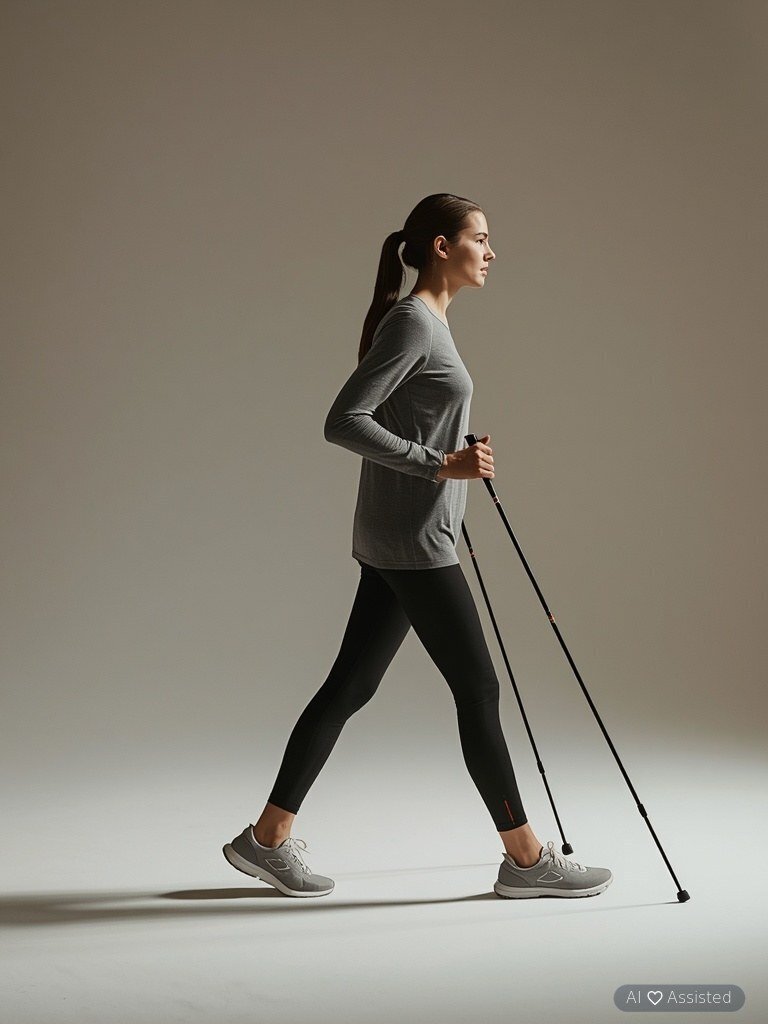
Learning the correct Nordic walking technique begins with a warm-up phase to prepare the body. Initially, practitioners should walk without poles, focusing on natural gait and alternating arm swings to establish diagonal coordination (left leg, right arm).
Next, holding the poles loosely without gripping tightly allows the user to get accustomed to the rhythm. The motion must originate from the shoulder joint rather than the elbow. When the hand moves forward, it grips the handle; when it swings backward past the hip, the hand opens, releasing the pole while it remains secured by the strap.
During the walk, the posture must remain upright, the core engaged, and elbows relatively relaxed. Steps should be slightly longer than in normal walking, striking the heel first, rolling through the midfoot, and pushing off dynamically from the toes to maximize propulsion and efficiency.
Health Benefits and Impact on the Organism
Nordic walking stands out as an exceptionally effective yet low-impact discipline. When executed with proper technique, it engages up to 90% of the total body musculature, significantly outperforming traditional running or swimming. Furthermore, while an ordinary walk burns about 280 kcal per hour, the inclusion of poles can elevate energy expenditure up to 400 kcal per hour.
Scientific studies confirm that Nordic walking increases oxygen uptake by 20–58%, depending on exertion and pole-pushing intensity. Heart rate rises moderately, improving cardiovascular output and reducing heart attack risks. Regular sessions optimize lipid profiles, lower LDL cholesterol, aid in diabetes prevention, and strengthen bones to mitigate osteoporosis risks.
Ultimately, Nordic walking bridges accessibility and profound health benefits. Avoiding common technical pitfalls through professional instruction ensures practitioners fully reap its cardiovascular, metabolic, and musculoskeletal rewards.
Tags

Anna Schmidt
✓Diets Premium Expert
Diets Premium team expert. Specializes in nutrition plans, strength sports, and training plans.
View Profile →