Wheat Flour – Types, Nutritional Value, Caloric Density, and Culinary Uses

Anna Schmidt
Anna Schmidt ✓
Diets Premium Expert • 23.10.2026
✓
Scientifically reviewed by a clinical dietitian: This article has been peer-reviewed for adherence to IŻŻ, WHO, and PTGiP clinical nutritional standards.
Diets Premium Expert Anna Schmidt min read 2 min Scientifically reviewed by a clinical dietitian 23.10.2026
Wheat Flour – Types, Nutritional Value, Caloric Density, and Culinary Uses

Smart Voice

•

Listen to the article content live

0:00 / 0:00
Key Takeaways

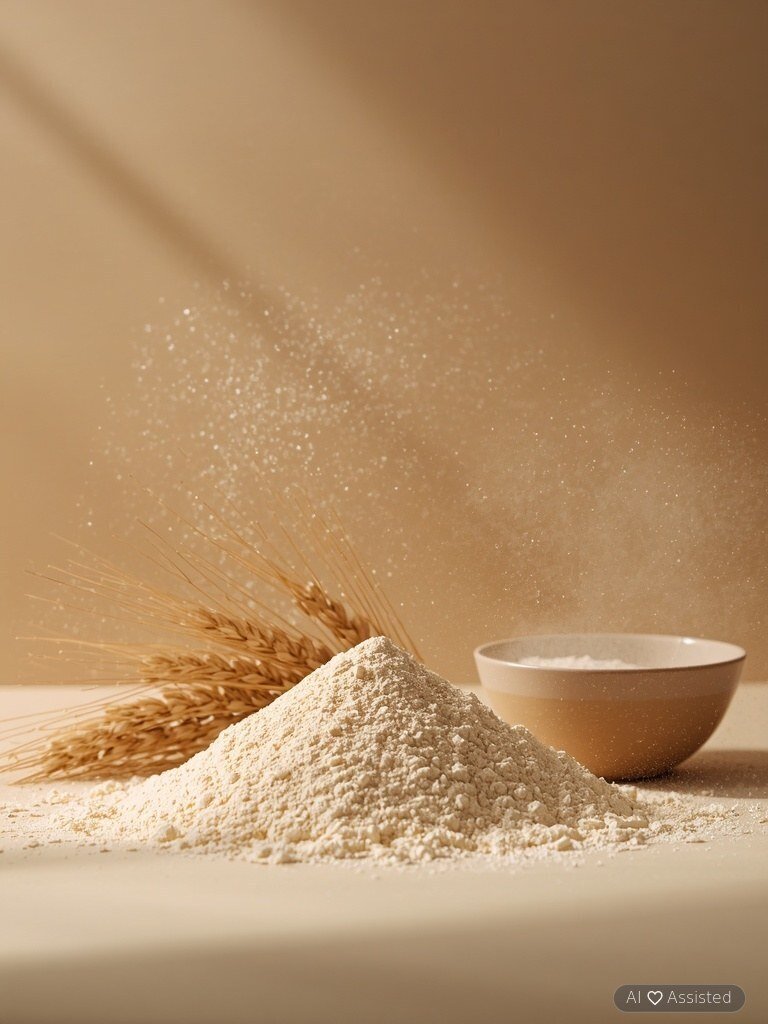
Wheat flour, milled from common wheat kernels (Triticum aestivum), serves as the most widely consumed cereal milling commodity globally. Its definitive technological asset is its gluten-forming protein matrix (gliadins and glutenins), which hydrates into a viscoelastic network that traps fermentation gases. The biological nutritional yield of wheat flour is inextricably tied to its milling extraction rate—spanning from refined white pastry flour to fiber-dense whole-wheat graham flour.

Meal Plan

Want to apply these guidelines in your daily diet?

Our smart diet generator creates a tailored meal plan in 3 minutes based on the recommendations in this article.

Nutritional Value of Wheat Flour – Vitamins, Minerals, and Fiber

The chemical composition of wheat flour shifts profoundly across milling extraction gradients:

  • Whole-grain flours (Types 1850 and 2000) – retaining intact bran and germ layers, they provide significant quantities of magnesium (~138 mg/100 g), non-heme iron, zinc, phosphorus, and B vitamins (thiamine, niacin). Dietary fiber (11–12 g/100 g) fosters eubiotic gut microbiome motility.
  • Refined white flours (Types 450 and 500) – stripped of outer coats, they comprise over 75% digestible starch and storage proteins, yielding barely 2–3 g of fiber and negligible trace elements (ash <0.5%).

Energy Value and Macronutrient Profile – Caloric Density of Wheat Flour

The baseline caloric and macronutrient density remains relatively steady across milling grades:

  • Caloric density – 100 g yields roughly 340–360 kcal.
  • Carbohydrates (68–74 g) – dominated by starch polymers; refined flours elicit rapid enzymatic digestion (glycemic index GI = 70–85), whereas whole-meal matrices temper glycemic curves.
  • Protein (10–13 g) – storage prolamins comprising monomeric gliadin (providing extensibility and viscosity) and polymeric glutenin (supplying elasticity and tensile strength).
  • Lipids (1–2 g) – essential polyunsaturated fatty acids localized within the germ.

Culinary Applications Across Wheat Flour Types

Precise selection of the appropriate flour grade ensures culinary and baking triumph:

  • Pastry flour (Type 450 / Type 405) – lowest extraction rate, optimal for airy sponge cakes, delicate souffles, and light batters.
  • All-purpose flour (Type 500 / Type 550) – versatile standard for dumplings (pierogi), crepes, shortcrust pastry, and roux.
  • Strong bread flour (Type 650 to 850) – robust gluten framework ideal for artisan baguettes, yeast brioche, pizza dough, and focaccia.
  • Whole-wheat and graham (Types 1850 and 2000) – coarse milling yielding dense rustic loaves, sourdough breads, and fiber-rich crackers.
Anna Schmidt

Anna Schmidt

✓

Diets Premium Expert

Diets Premium team expert. Specializes in nutrition plans, strength sports, and training plans.

View Profile →
Recommended articles in this category

Related Articles

Discover similar publications and expert insights.

Wheat and Rye Flour – Type Classification, Ash Content, Nutritional Properties, and Baking Applications
Food Science
Wheat and Rye Flour – Type Classification, Ash Content, Nutritional Properties, and Baking Applications
⏱ 3 min czytania 📚 Food Science
#Wheat Flour #Cornmeal
Rice Noodles – Varieties, Nutritional Profile, Glycemic Index, and Culinary Recipes
Food Science
Rice Noodles – Varieties, Nutritional Profile, Glycemic Index, and Culinary Recipes
⏱ 2 min czytania 📚 Food Science
#Rice Noodles #Magnesium
Coconut Flour – Nutritional Profile, Low Glycemic Index, and Culinary Uses in Keto and Gluten-Free Diets
Food Science
Coconut Flour – Nutritional Profile, Low Glycemic Index, and Culinary Uses in Keto and Gluten-Free Diets
⏱ 2 min czytania 📚 Food Science
#Cardiovascular Diseases #Complete Protein
Peanut Butter and Paste: Comprehensive Nutritional Density, Health Profile, and Dietary Applications
Food Science
Peanut Butter and Paste: Comprehensive Nutritional Density, Health Profile, and Dietary Applications
⏱ 3 min czytania 📚 Food Science
#Metabolic Efficiency #Fetal Development
Wild marjoram essential oil – therapeutic applications, usage restrictions, and recommended dosing protocols
Culinary Spice
Wild marjoram essential oil – therapeutic applications, usage restrictions, and recommended dosing protocols
⏱ 4 min czytania
#Culinary Spice #Mediterranean
The evolution, types, preparation techniques, and regional Polish adaptations of pizza
Quick Meal
The evolution, types, preparation techniques, and regional Polish adaptations of pizza
⏱ 4 min czytania
#Quick Meal #Italian
Lutein – Properties, Natural Dietary Sources, and Ocular Benefits: A Comprehensive Guide to Carotenoid Health
Functional Foods
Lutein – Properties, Natural Dietary Sources, and Ocular Benefits: A Comprehensive Guide to Carotenoid Health
⏱ 4 min czytania 📚 Functional Foods
#Fermented Beverages #Health Benefits
Manufacture and Legal Regulations of Deep-Frozen Cakes
Baked Goods
Manufacture and Legal Regulations of Deep-Frozen Cakes
⏱ 4 min czytania
#Baked Goods #Crispy
How to Use Alum? Learn About Its Properties, Applications, and Potential Harmful Effects
Natural Foods
How to Use Alum? Learn About Its Properties, Applications, and Potential Harmful Effects
⏱ 6 min czytania
#Natural Foods #Mineral
Alternative Calcium Sources for a Dairy-Free Diet
Dairy-Free Diet
Alternative Calcium Sources for a Dairy-Free Diet
⏱ 3 min czytania
#Dairy-free Diet #Dairy Alternative
Fluoride – Properties and Harmful Effects
Magnesium
Fluoride – Properties and Harmful Effects
⏱ 3 min czytania
#Magnesium #Mineral
Bioavailability of Mineral Constituents in Food Products
Mineral
Bioavailability of Mineral Constituents in Food Products
⏱ 4 min czytania
#Mineral #Macronutrients
Purified sodium hydrogen carbonate - properties, household and medicinal use
Cleaning
Purified sodium hydrogen carbonate - properties, household and medicinal use
⏱ 5 min czytania
#Cleaning #Homemade
Iron - Requirement and absorption of the essential mineral
Mineral
Iron - Requirement and absorption of the essential mineral
⏱ 6 min czytania
#Mineral #Iron
Barley groats
Pregnancy & Motherhood
Barley groats
⏱ 2 min czytania 📚 Pregnancy & Motherhood
#Gluten #Zinc
Cardamom - Flawless Spice for Rice Dishes
Health
Cardamom - Flawless Spice for Rice Dishes
⏱ 1 min czytania 📚 Health
#Sweet #Savory
Water therapy - various types of therapeutic water that provide relief for many diseases
Diabetes
Water therapy - various types of therapeutic water that provide relief for many diseases
⏱ 5 min czytania
#Diabetes #Mineral
Vitamin D, its significance, deficiencies and sources in nutrition
Nutrition
Vitamin D, its significance, deficiencies and sources in nutrition
⏱ 5 min czytania
#Nutrition #Mineral
It's a Remarkable Herb Called Mint
Carbohydrates
It's a Remarkable Herb Called Mint
⏱ 2 min czytania
#Carbohydrates #Magnesium
Magnesium - An Invaluable Mineral Component
Magnesium
Magnesium - An Invaluable Mineral Component
⏱ 4 min czytania
#Magnesium #Electrolyte
Selenium – A Vital Dietary Component for Men
Mineral
Selenium – A Vital Dietary Component for Men
⏱ 3 min czytania
#Mineral #Selenium
Essential Pear
Fluid Balance
Essential Pear
⏱ 2 min czytania
#Fluid Balance #Balance
Excessive iron in diet: Causes, symptoms, and health consequences
Mineral
Excessive iron in diet: Causes, symptoms, and health consequences
⏱ 4 min czytania
#Mineral #Nutrition
Therapeutic Mineral Applications – Professional Perspectives, Usage Guidelines, and the Distinctive Properties of Natural Stones Alongside Their Physiological and Psychological Effects
Nutritional Science
Therapeutic Mineral Applications – Professional Perspectives, Usage Guidelines, and the Distinctive Properties of Natural Stones Alongside Their Physiological and Psychological Effects
⏱ 6 min czytania 📚 Nutritional Science
#Mineral #Mental
Mascarpone Cheese: Velvety Italian Delicacy, Culinary Heritage, Nutritional Profile, and Gastronomic Uses
Cream Cheese
Mascarpone Cheese: Velvety Italian Delicacy, Culinary Heritage, Nutritional Profile, and Gastronomic Uses
⏱ 2 min czytania
#Cream Cheese #Sweet Flavor
Homemade peanut butter – comprehensive ingredient breakdown and a step-by-step preparation guide
Food Science
Homemade peanut butter – comprehensive ingredient breakdown and a step-by-step preparation guide
⏱ 4 min czytania 📚 Food Science
#Nutrient-Rich #Peanut Butter
Passion fruit – nutritional characteristics, purchasing locations, pricing, and practical guidelines for its consumption
Fruits
Passion fruit – nutritional characteristics, purchasing locations, pricing, and practical guidelines for its consumption
⏱ 4 min czytania 📚 Fruits
#Dietary Supplements #Functional Foods
Slippery Jack (Suillus luteus): Identification, Nutritional Value, and Culinary Applications
Food Science
Slippery Jack (Suillus luteus): Identification, Nutritional Value, and Culinary Applications
⏱ 4 min czytania 📚 Food Science
#Culinary Uses #Mushrooms
Chestnut Flour – Nutritional Profile, Natural Sweetness, Market Value, and Culinary Recipes
Food Science
Chestnut Flour – Nutritional Profile, Natural Sweetness, Market Value, and Culinary Recipes
⏱ 5 min czytania 📚 Food Science
#Healthy Eating #Healthy Meals
Tapioca Flour (Cassava Starch) – Properties, Glycemic Index, and Culinary Recipes
Food Science
Tapioca Flour (Cassava Starch) – Properties, Glycemic Index, and Culinary Recipes
⏱ 4 min czytania 📚 Food Science
#Versatile Ingredient #Tapioca

Share