5 min read
Processing, frying, grilling, cooking - properly processed pork can be healthy!

Mia Hoffmann
✓
Diets Premium Expert • 24.09.2026
✓
Scientifically reviewed by a clinical dietitian:
This article has been peer-reviewed for adherence to IŻŻ, WHO, and PTGiP clinical nutritional standards.
| Diets Premium Expert Mia Hoffmann | min read 5 min | Scientifically reviewed by a clinical dietitian 24.09.2026 |
Smart Voice
•Listen to the article content live
0:00
/
0:00
Key Takeaways
Through the commitment of breeders and the cross-breeding of suitable breeds and individuals, increasingly productive slaughter animals are being obtained. The application of technologies from countries with high-quality meat production, such as Denmark (the largest producer of pork in the Union), has resulted in very good meat outcomes. Today's pork contains much less fat than before, making it less caloric. The national breeding of these animals is a highly valued meat source in Europe, therefore it is worth learning about the characteristics of this meat.
Meal Plan
Want to apply these guidelines in your daily diet?
Our smart diet generator creates a tailored meal plan in 3 minutes based on the recommendations in this article.
A Comprehensive Guide to Preparing Pork: From Selection to Culinary Processing
The most advisable practice is to source meat from small-scale, reputable producers or dedicated butcher shops where quality takes precedence over cost-cutting measures. Within large supermarket chains, where price pressures often compel manufacturers to compromise on standards, identifying high-quality products—particularly hams free from artificial enhancers such as flavor boosters or preservatives—can prove challenging. A critical selection criterion is the meat’s coloration: shades ranging from light to deep pink typically indicate freshness and proper animal nutrition, whereas grayish or brownish hues may signal spoilage or improper storage conditions. Given pork’s widespread availability and affordability, it is generally recommended to avoid prolonged freezing in favor of purchasing fresh cuts. Should freezing become necessary, the duration should not exceed six months. Prior to preparation, the meat must be thoroughly rinsed under running water to eliminate surface contaminants. The subsequent step involves trimming excess fat, though it is important to retain a moderate amount—particularly intramuscular fat—which plays a pivotal role in ensuring juiciness, flavor depth, and tenderness in the final dish. Fat acts as a flavor carrier, a property that is especially valuable during frying, grilling, or roasting. For lean cuts, this step may be omitted. Pork pairs exceptionally well with herbs such as marjoram, thyme, rosemary, caraway, and savory, as well as with garlic—preferably freshly crushed. Before subjecting the meat to heat treatment, it should be brought to room temperature to ensure even cooking. The required duration for this process ranges from 20–30 minutes for smaller pieces to up to two hours for larger roasting cuts.
Pan-fried pork: a culinary and biochemical examination of preparation techniques
A pivotal determinant of the final flavor profile and culinary quality lies in both the selection of the fat medium employed and the meticulous regulation of thermal parameters throughout the cooking process. Utilizing lower temperatures during frying facilitates enhanced lipid infiltration into the muscle tissue, which consequently elevates the dish’s overall caloric density. Conversely, initiating the process at higher temperatures mitigates this effect by inducing rapid coagulation of surface proteins, thereby forming a protective barrier. Achieving an internal temperature of 85°C is essential for properly cooked pork, ensuring both microbiological safety and the desired textural characteristics. However, exposure to elevated heat may trigger the thermal degradation of labile nitrogenous compounds, particularly the essential amino acids lysine, threonine, and the sulfur-containing methionine.
An inevitable phenomenon accompanying frying is the potential Maillard reaction—a complex chemical interaction between reducing sugars and free amino groups—that yields the distinctive golden-brown, crispy crust, most pronounced when the meat is pre-coated in breadcrumbs or flour-based batter. Research indicates that losses of B-complex vitamins (primarily thiamine, riboflavin, and niacin) remain relatively minimal, whereas mineral components such as iron, zinc, and phosphorus exhibit high resistance to thermal degradation.
**Critical technological considerations:** Exceeding the smoke point of the fat (approximately 220°C for traditional lard, 170°C for extra virgin olive oil, and 230°C for clarified butter) results in the generation of harmful aldehydic compounds and acrolein, alongside a deterioration of the dish’s organoleptic properties. The recommended thermal range for efficient frying spans 130–160°C, with an absolute ceiling of 180°C to prevent carbonization. The fat quantity should constitute roughly 10% of the raw meat’s mass—this proportion ensures uniform heat conduction without excessive greasiness. Preheating the pan to the target temperature before adding the meat is equally crucial to avoid "steaming in its own juices" rather than achieving a proper sear.
**Preferred cuts of pork:** loin (particularly the tenderloin), ham (either bone-in or boneless, depending on the recipe).
Oven-roasted pork – high-temperature thermal processing technique preserving moisture and flavor complexity
Roasting involves exposing meat to dry heat at temperatures approaching 100°C, though the internal temperature of larger cuts never actually reaches this threshold, remaining consistently lower. A defining characteristic of the process is the periodic basting of the meat with its own rendered juices, which, upon evaporation, form a crisp, caramelized crust on the exterior. However, this method incurs substantial losses of B-complex vitamins—including thiamine (B₁), riboflavin (B₂), and niacin (B₃)—many of which leach into the resulting pan drippings alongside nitrogenous compounds and mineral constituents. Only premium cuts with minimal connective tissue are suitable for roasting, as collagen fails to break down without moisture. Ideal candidates include large, intact pieces such as bone-in ham, whole rib sections, or bone-in loin, which are less prone to drying out during prolonged exposure to heat.
Succulent grilled pork cuts: preparation techniques and optimal thermal processing duration
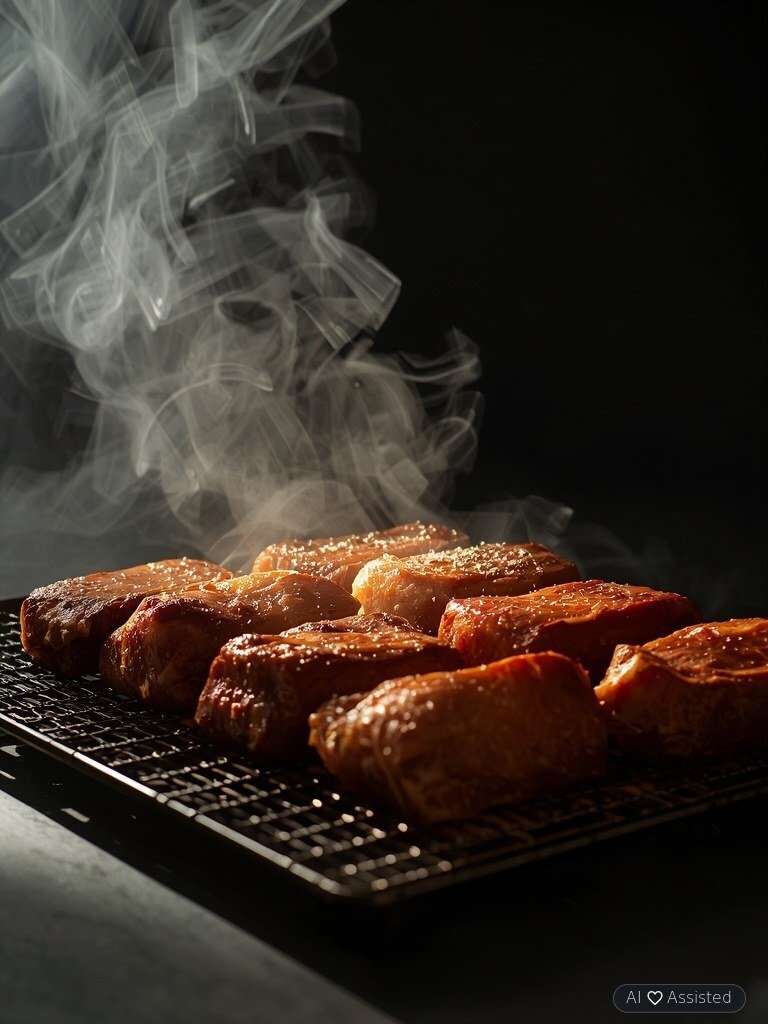
To achieve exceptional flavor and juiciness in grilled pork, it is highly recommended to marinate the meat in aromatic seasonings for at least 24 hours prior to cooking. The grilling process itself should last between 10 and 15 minutes—with the exact duration dependent on the thickness of the cut and the specific part of the carcass being prepared. A critical step involves flipping the meat exactly once at the midpoint of cooking to ensure even doneness. The degree of doneness can be finely adjusted by reducing or extending the exposure to heat by approximately 2–3 minutes. Particularly well-suited for grilling are: bone-in pork chops (renowned for their exceptional juiciness), pork neck steaks (offering an intense flavor profile), mixed pork-poultry kebabs (combining diverse textures), and pork belly (perfect for achieving a crispy exterior).
Thermally processed pork via boiling in liquid or steam exposure
The cooking process involves the sustained exposure of pork meat or its byproducts to a stable temperature approaching 100°C, achieved either through submersion in water or exposure to steam. This treatment induces irreversible denaturation of protein structures distributed throughout the raw material, thereby altering their three-dimensional conformation. The elevated temperature effectively neutralizes the majority of microbiological pathogens, including vegetative bacterial forms, yeast cells, mold spores, and certain bacterial toxins (such as botulinum toxin), along with parasitic organisms. To optimize the retention of water-soluble vitamins, the meat should be placed directly into boiling water; conversely, when preparing a flavorful broth, the raw material is introduced into cold water at the outset. The most substantial mass losses (ranging from 1% to 4% of the initial weight) occur within the first hour of cooking. Nutrients partially migrate into the broth: nitrogenous compounds are reduced by 4–10%, lipids by 1–30%, while mineral components (ash) may decrease by as much as 20–60%. Pork is distinguished by its exceptional gustatory qualities and remarkable ease of preparation, making it an ideal choice for novice cooks. Unlike other varieties of red meat, such as beef or lamb, it does not necessitate complex culinary techniques to achieve a tender texture.

Mia Hoffmann
✓Diets Premium Expert
Diets Premium team expert. Specializes in nutrition plans, strength sports, and training plans.
View Profile →