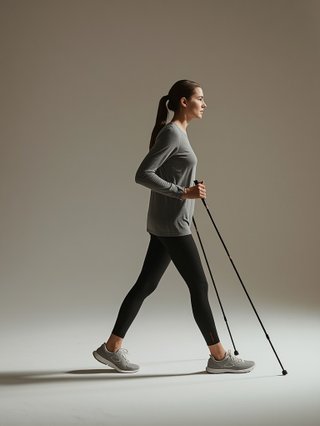
Four-limb training - Nordic Walking


Table of Contents 5
Medical & Editorial Disclaimer (§3 Terms): This article is for informational and educational purposes only, does not constitute medical advice, diagnosis, or treatment, and is used at your own risk. Consult a qualified physician for medical conditions.
Physiologically, the use of poles transforms a standard walk into a full-body workout by engaging a much broader range of muscle groups. This technique strengthens the arms, chest, and core, while simultaneously providing relief to the knees and lumbar spine. By distributing the workload more evenly across the motor apparatus, Nordic Walking contributes to better body stabilization and helps reduce the risk of strain or injury compared to traditional walking.
To maximize the benefits of this discipline, it is essential to select poles of the correct length relative to one's height and to master the proper movement technique. Beginners should focus on consistency and form before gradually increasing the distance or intensity of their sessions. Whether practiced on flat urban paths or uneven forest trails, Nordic Walking is a versatile exercise that can be adapted to any environment, even incorporating running techniques once proficiency is achieved.
What are the genuine differences between Nordic walking and regular walking?
Benefits of practicing Nordic Walking
Muscle engagement during the practice of Nordic walking
Are these genuinely nordic walking sticks? How to move with their assistance?
Employing Nordic walking poles during running
Want to apply these guidelines in your daily diet?
Our smart diet generator creates a tailored meal plan in 3 minutes based on the recommendations in this article.

mgr Mateusz Pawlak
• 25.11.2026Diets Premium Expert
Diets Premium team expert. Specializes in nutrition plans, strength sports, and training plans.