Woman at the gym – physiology of female strength training, debunking myths, and effective body sculpting


Table of Contents 7
Medical & Editorial Disclaimer (§3 Terms): This article is for informational and educational purposes only, does not constitute medical advice, diagnosis, or treatment, and is used at your own risk. Consult a qualified physician for medical conditions.
Modern exercise physiology reveals that resistance training triggers profound hormonal, neurological, and skeletal adaptations that are vital for women. By understanding the role of the menstrual cycle in training readiness and the importance of mechanical tension for bone density, women can optimize their physical development. Lifting free weights does not compromise femininity; rather, it supports the structural integrity of the body, enhances insulin sensitivity, and promotes long-term orthopedic resilience.
To achieve lasting results, it is crucial to move beyond restrictive dietary habits and embrace a training approach that balances lower and upper body development. Providing the body with adequate fuel is necessary to sustain hormonal health and support recovery from progressive training sessions. By prioritizing scientific principles over myths, women can effectively shape their physique, improve functional strength, and foster a sustainable, healthy lifestyle.
For decades, the weight room in commercial fitness centers was shaped by outdated stereotypes: while men gathered around barbells, squat racks, and heavy cable stations, women were frequently steered by societal narratives and pervasive fitness myths toward treadmills, ellipticals, or group classes featuring tiny, light dumbbells. The deeply ingrained fear that genuine resistance training would inevitably produce a bulky, masculine physique kept millions of women away from the single most effective tool for body recomposition, metabolic longevity, and orthopedic health.
Modern sports science and exercise physiology paint a completely different, evidence-based picture today. Female strength training driven by progressive overload does not strip away femininity; rather, it sculpts the exact toned, firm, and athletic silhouette that endless cardiovascular exercise and severe caloric restriction can never achieve. Beyond aesthetics, lifting free weights triggers profound hormonal, neurological, and skeletal adaptations—ranging from osteoporosis prevention and enhanced insulin sensitivity to remarkable improvements in mental resilience and daily functional strength. This comprehensive guide explores female exercise physiology in depth and demonstrates how women can structure their training and nutrition on solid scientific principles.
The Evolution of Female Training: Why the Free Weight Zone Is the Key to a Toned and Healthy Physique
Many women embark on their fitness journey aiming to 'tone' their body, reduce subcutaneous adipose tissue, and sculpt harmonious proportions. In practice, however, beginners often rely exclusively on hours of steady-state cardiovascular exercise combined with severe caloric restriction. The physiological outcome of this strategy is rarely a firm, athletic figure; instead, it frequently produces the 'skinny-fat' phenomenon. While total scale weight drops, the lack of mechanical tension causes the body to catabolize metabolically expensive skeletal muscle tissue alongside fat, leaving body fat percentage relatively high, basal metabolic rate suppressed, and tissue appearing soft rather than sculpted.
From an anatomical and physiological standpoint, what popular culture calls 'toning' or 'firming' is simply the combination of two distinct biological processes: building underlying skeletal muscle hypertrophy and maintaining a healthy, moderate level of subcutaneous fat. Only progressive resistance training in the free weight zone generates sufficient mechanical tension to stimulate muscle fibers effectively:
- Elevation of Resting Metabolic Rate (RMR) – Skeletal muscle is metabolically active tissue. Expanding and preserving lean muscle mass increases 24-hour energy expenditure, even during complete rest and sleep.
- Excess Post-Exercise Oxygen Consumption (EPOC) – Following heavy multi-joint resistance sessions, oxygen uptake and caloric expenditure remain elevated for 24 to 48 hours to fuel myofibrillar repair, glycogen resynthesis, and protein turnover.
- Functional Joint Stability and Real-World Strength – Compound free-weight movements recruit deep core stabilizers and neuromuscular coordination, protecting joints from injury and making daily physical tasks effortless.
Female Hormonal Physiology and Hypertrophy: The Role of Estrogen, Progesterone, and Low Testosterone
The single most persistent myth in female fitness is the belief that lifting heavy weights will rapidly transform a woman into a bulky, masculine bodybuilder. A basic examination of human endocrinology immediately dispels this fear. The primary hormonal driver behind extreme skeletal muscle mass and masculine muscularity is the androgenic steroid hormone testosterone. While healthy adult males maintain total serum testosterone concentrations between 300 and 1,000 ng/dL, the physiological reference range in healthy females is merely 15 to 70 ng/dL—roughly 10 to 15 times lower than in men.
Because of this fundamental endocrine difference, it is biologically impossible for a woman training naturally to accidentally develop massive, masculine muscle bulk. At the same time, women possess a unique hormonal profile that strongly supports neuromuscular adaptation and recovery in its own right. Estrogens—specifically 17β-estradiol—play a remarkably beneficial role in skeletal muscle physiology:
- Membrane-Protective and Anti-Catabolic Effects of Estradiol – Estrogen stabilizes the sarcolemma (muscle cell membrane), blunts exercise-induced oxidative muscle damage, and enhances satellite cell proliferation following resistance training.
- Superior Fatigue Resistance and Lipid Oxidation – Females typically exhibit a higher proportion of oxidative Type I muscle fibers and greater capillary density, allowing them to recover significantly faster between heavy sets than males of comparable relative strength.
- Compensatory Growth Hormone (GH) and IGF-1Signaling – To compensate for lower androgen levels, the female neuroendocrine system relies more heavily on pulsatile growth hormone (GH) and insulin-like growth factor-1 (IGF-1) release during heavy resistance exercise, promoting lean tissue remodeling, collagen integrity, and fat mobilization.
Menstrual Cycle-Synced Training Periodization: Optimizing Follicular, Ovulatory, and Luteal Phases
Unlike the male endocrine system, which operates primarily on a predictable 24-hour circadian rhythm, women of reproductive age experience an infradian biological rhythm lasting roughly 25 to 35 days: the menstrual cycle. Cyclical fluctuations in estradiol, progesterone, luteinizing hormone (LH), and follicle-stimulating hormone (FSH) directly influence core body temperature, substrate utilization, ligamentous laxity, pain perception, and central nervous system readiness. Synchronizing training variables with these hormonal shifts allows women to maximize strength adaptations while minimizing burnout.
Cycle-aware periodization does not impose rigid restrictions; rather, it dynamically calibrates volume, intensity, and recovery strategies across three main physiological windows:
- Follicular Phase (Day 1 to ~Day 13) – Following the onset of menses, progesterone remains low while estradiol steadily climbs. Insulin sensitivity, muscle glycogen storage capacity, pain tolerance, and satellite cell activity are all elevated. This phase represents the optimal window for high training volume, progressive overload, and high-intensity strength blocks.
- Ovulatory Phase (~Day 14) – Estradiol reaches its peak concentration alongside a surge in LH. Many lifters experience peak neuromuscular force production during these days. However, peak estrogen can transiently increase laxity in tendons and ligaments (such as the anterior cruciate ligament), making meticulous warm-ups and strict biomechanical control essential.
- Luteal Phase (~Day 15 to Day 28) – After ovulation, progesterone becomes the dominant hormone. Basal body temperature rises by 0.3–0.5°C, resting energy expenditure increases slightly, and perceived exertion (RPE) tends to climb. During the late luteal days, slightly moderating total volume or scheduling a strategic deload helps respect recovery capacity.
Strength Training for Osteoporosis Prevention (Bone Mineral Density), Metabolic Health, and Insulin Sensitivity
Beyond its undeniable aesthetic benefits, progressive resistance training serves as the single most potent preventive medical intervention for women across the lifespan. Due to smaller peak skeletal frame size and the sharp decline in endogenous estrogen during perimenopause and postmenopause, women face a significantly higher lifetime risk of osteopenia and osteoporosis than men. Bone is not an inert mineral scaffold; it is living, dynamic tissue governed by Wolff's Law and the mechanostat theory.
When skeletal muscles contract against substantial external resistance, tendons exert mechanical tensile and compressive forces upon the periosteum. This micro-strain stimulates osteocytes and osteoblasts to deposit new collagen and hydroxyapatite crystals into the bone matrix. Simultaneously, resistance training acts as a powerful regulator of systemic endocrine and metabolic health:
- Enhancement of Bone Mineral Density (BMD) – Multi-joint axial-loading exercises such as squats, deadlifts, and overhead presses significantly increase bone density at the lumbar spine and femoral neck, drastically reducing fracture risk later in life.
- GLUT-4 Translocation and Insulin Sensitivity – Contracting muscle fibers translocate GLUT-4 glucose transporters to the cell membrane independently of insulin, clearing blood glucose efficiently. This makes strength training a frontline therapy for women managing insulin resistance or Polycystic Ovary Syndrome (PCOS).
- Secretion of Protective Myokines – Working muscles function as an endocrine organ, releasing anti-inflammatory myokines that improve endothelial function, lipid profiles, and systemic metabolic flexibility.
Biomechanics of Lower Body and Glute Sculpting: Hip Thrusts, Squats, Romanian Deadlifts, and Abductions
Sculpting strong, shapely legs and lifted, rounded glutes is one of the primary aesthetic and functional goals for women in the weight room. Achieving optimal lower-body development requires a clear understanding of hip anatomy and biomechanics. The gluteal complex comprises three distinct muscles: the gluteus maximus, which drives powerful hip extension and posterior projection, and the gluteus medius and gluteus minimus, which control hip abduction, external rotation, pelvic stability, and the upper-outer contour of the hips.
An evidence-based lower-body training program integrates multiple force vectors and resistance profiles to load the musculature across both lengthened and shortened ranges of motion:
- Barbell Hip Thrusts and Kas Glute Bridges (Horizontal Vector) – Horizontal hip extension exercises place peak mechanical torque at full hip lock-out (the fully shortened position of the gluteus maximus), generating maximal motor unit recruitment without excessive shear stress on the lower back.
- Deep Squats, Lunges, and Bulgarian Split Squats (Vertical/Unilateral Vectors) – Knee- and hip-flexion compound patterns load the gluteus maximus and quadriceps under deep stretch (lengthened position), triggering powerful stretch-mediated hypertrophy and unilateral pelvic stabilization.
- Romanian Deadlifts (RDL) and Cable Hip Abductions – RDLs target the hamstrings and glute-hamstring tie-in through controlled eccentric hip hinging, while standing cable abductions or seated abduction variations isolate the gluteus medius to create a balanced, athletic hip silhouette.
The Importance of Upper Body Training for Balanced Proportions (Hourglass Silhouette) and Spinal Posture
A common programming mistake among female trainees is dedicating 90 percent of their gym time exclusively to legs and glutes while completely neglecting the upper body out of fear of developing broad, masculine shoulders. From both an aesthetic and orthopedic perspective, the exact opposite holds true: the classic, balanced hourglass silhouette is defined by the visual symmetry between the shoulder girdle, upper back, waist, and hips. Developing toned deltoids and a sculpted upper back creates a subtle V-taper that immediately makes the waist appear narrower and more defined.
Furthermore, in an era dominated by desk work and prolonged smartphone use, upper-body strength is essential for cervical and thoracic spine health, postural alignment, and injury prevention:
- Vertical and Horizontal Pulling (Lat Pulldowns, Rows, Assisted Pull-Ups) – Strengthening the latissimus dorsi, rhomboids, and mid-to-lower trapezius counteracts rounded shoulders (thoracic kyphosis), opens the chest, and builds an elegant, upright posture.
- Deltoid and Rotator Cuff Development (Lateral Raises, Overhead Presses, Face Pulls) – Targeting the lateral and posterior deltoid heads stabilizes the glenohumeral joint and frames the upper torso symmetrically with the lower body.
- Pressing and Triceps Movements (Push-Ups, Dumbbell Presses, Cable Extensions) – Strengthening the pectoral muscles and the three heads of the triceps firms the back of the upper arms and provides functional pushing strength for everyday life.
Nutrition for Physically Active Women: Avoiding Low Energy Availability (RED-S), Protein, Iron, and Omega-3 Intake
Even the most scientifically designed resistance program will fail to deliver results if the female body is chronically under-fueled. Many active women fall into the trap of combining severe 1,200-calorie diets with high-volume training. When daily Energy Availability (EA) drops below the critical physiological threshold of roughly 30 kcal per kilogram of fat-free mass (FFM), the hypothalamus downregulates reproductive and metabolic hormones to conserve energy. Clinically recognized as RED-S (Relative Energy Deficiency in Sport), this state leads to menstrual dysfunction (hypothalamic amenorrhea), suppressed thyroid output (low T3), impaired muscle recovery, and accelerated bone loss.
A performance-supporting, hormone-friendly nutritional strategy for strength-training women rests on several non-negotiable pillars:
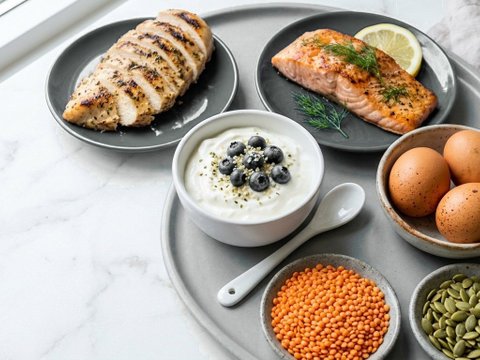
- Optimal Protein Intake (1.6 to 2.2 g per kg of body weight) – Complete dietary proteins rich in essential amino acids and leucine stimulate muscle protein synthesis (MPS), preserve lean tissue during mild fat-loss phases, and support collagen, hair, and nail integrity.
- Balanced Carbohydrates and Essential Dietary Fats – Complex carbohydrates replenish intramuscular glycogen and maintain healthy leptin and thyroid signaling, while dietary fats (at least 0.8–1.0 g/kg) provide the cholesterol backbone required for endogenous steroid hormone synthesis.
- Key Micronutrients: Iron, Vitamin D3, Calcium, and Omega-3s (EPA/DHA) – Due to menstrual blood loss, active women must monitor serum ferritin levels closely and prioritize heme iron, vitamin D3, magnesium, and anti-inflammatory marine omega-3 fatty acids.
Want to apply these guidelines in your daily diet?
Our smart diet generator creates a tailored meal plan in 3 minutes based on the recommendations in this article.
Tags

Oliwia Kaczmarek
• 25.11.2026Diets Premium Expert
Diets Premium team expert. Specializes in nutrition plans, strength sports, and training plans.